Home / Field notes / Note 2
Field note no. 2
How to tell a guillemot from a razorbill
Look at the bill first. A guillemot has a thin, pointed bill. A razorbill has a deep, blunt, black bill with a white mark across it. If the light is too poor to see the bill, colour helps: guillemots look chocolate brown above, razorbills blacker.
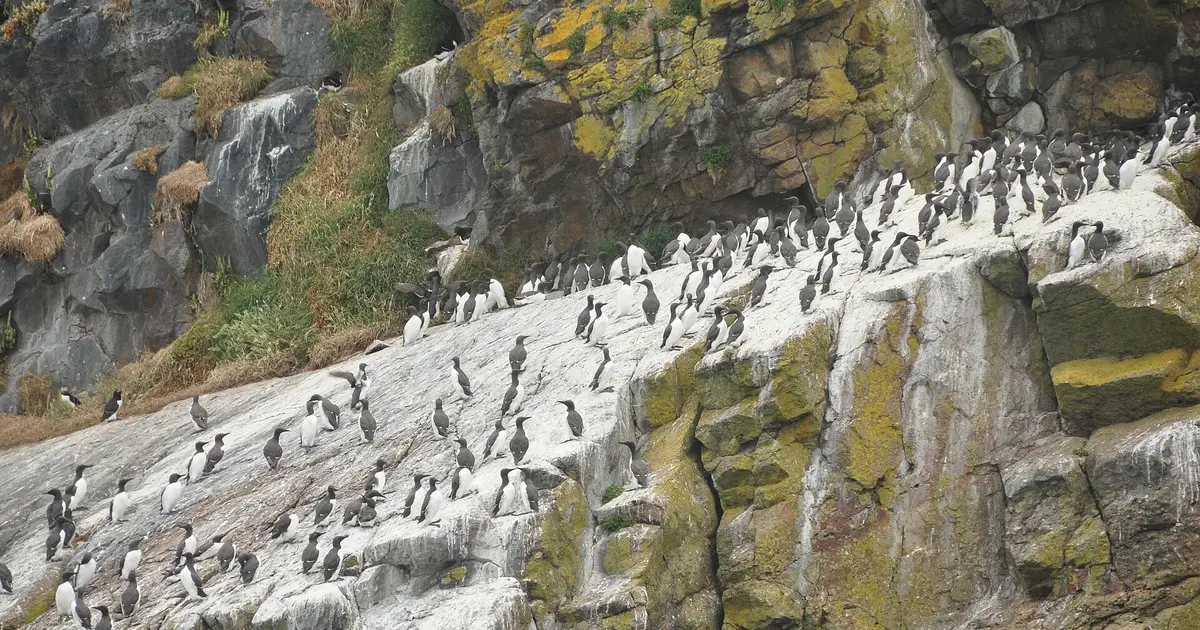

They share cliffs, they are both black-and-white auks, and they stand upright like small penguins. With practice you can separate them at a surprising distance. The steps below, drawn from the RSPB guillemot page, its razorbill page and The Wildlife Trusts, run in the order we would check them, starting with the feature that is hardest to get wrong.
A key to the two birds
This works the way an old field-guide key does. Read each pair of statements, choose the one that fits, and stop when you reach a name.
- 1aBill thin and pointed, with no white markings. Go to 2.
- 1bBill thick, deep and blunt, black with a white line crossing it. Razorbill.
- 2aUpperparts chocolate brown, or a white ring round the eye running back towards the neck. Guillemot.
- 2bUpperparts black, large pale cheeks, huge bright bill. You have a puffin, and we are pleased for you.
The species cards
Card A
Guillemot
Uria aalge
- Colour
- Chocolate brown above, white below. The RSPB calls it less black than the razorbill.
- Bill
- Thin, dark and pointed.
- Size
- 38 to 45 cm long, according to The Wildlife Trusts.
- Nest
- Narrow, exposed ledges, in tightly packed groups. No real nest.
- Egg
- One a year, pear-shaped.
Card B
Razorbill
Alca torda
- Colour
- Black on top and white below, neater and more contrasted.
- Bill
- Thick, deep and blunt, with a broken white line near the tip.
- Size
- Similar in length, but looks thick-set for its size.
- Nest
- Often in crevices or among boulders, tucked away more than a guillemot.
- Egg
- One, usually laid from late April to May.
The things that catch people out
Bridled guillemots
Some guillemots carry a white ring round the eye with a fine white line running back from it. The Wildlife Trusts call this the bridled form. It is a variation within the species, not a separate bird. Razorbills have a white line on the face too, but it runs forward from the eye to the base of the bill, so the direction tells you which you are looking at.
Brown is not always obvious
Guillemots in the south of Britain tend to look clearly brown, while those further north can look much darker. Flat northern light makes this harder still. Treat colour as supporting evidence and go back to the bill when you can.
Birds on the water
Both swim low and both dive. Razorbills have a longer, more pointed tail than most auks, and in flight a razorbill's feet do not reach beyond the tail, a detail that can help on a passing bird. Most people will need a telescope and a calm sea to use it, and there is no shame in writing "auk sp." in your notebook.
Winter birds
Outside the breeding season, guillemots have white faces with a dark line behind the eye, and the razorbill's throat and the sides of its face also turn white. These birds are mostly offshore then, so a winter sighting from land is often distant and brief. The RSPB notes that both species come ashore only to breed. A single auk close inshore in winter deserves a careful look, and if it seems unwell, our note on injured and dead seabirds explains what to do.
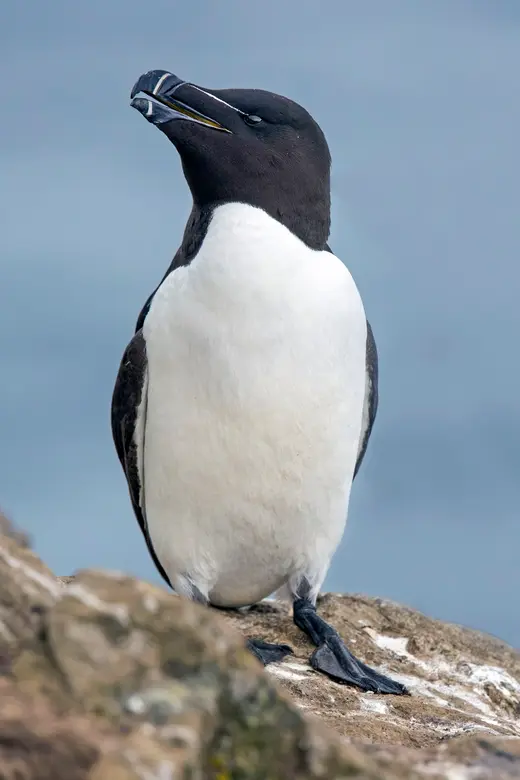 Photo: Charles J. Sharp, CC BY-SA 4.0, via Wikimedia Commons, cropped.

Where you can compare them side by side
The two species nest at many of the same places, which makes comparison easy. Both the RSPB's guillemot and razorbill pages list Bempton Cliffs, Troup Head, Fowlsheugh, Dunnet Head, South Stack, St Bees Head, Rathlin Island and Marwick Head in Orkney among their reserves. The Wildlife Trusts give March to July as the time to see guillemots at their colonies. Puffins on the same cliffs have a slightly shorter season, and our puffin note gives the dates.
One gap in the map is useful to know. The RSPB says there are no breeding razorbills between the Humber and the Isle of Wight, so along much of the English coast you are unlikely to meet a nesting bird at all.
Why bother telling them apart?
Partly for pleasure, because recognising a bird by shape changes how you look at a cliff. It also makes your records useful. Counts of these birds feed long-running population work, and the British Trust for Ornithology reports that the number of guillemots recorded in the Seabirds Count census was 8% lower than in the Seabird 2000 census, with the distribution also shifting. Both auks are Amber-listed on its species pages. An accurate record from a casual visitor, submitted through a recording scheme, adds a small piece to that picture.
The RSPB also points out that a bird spending most of its life at sea is vulnerable to oil spills, and that fishing nets, pollution and falling fish stocks all weigh on razorbills. So spending a few minutes getting the name right, from a respectful distance, is a modest way of paying attention to birds that are under pressure.
A note on keeping back
You do not need to get close to do any of this. A pair of binoculars and a well-placed viewpoint will show you the bill from a long way off. If birds on a ledge start to shuffle, call in alarm or fly off, you are too close. Our note on the law on disturbing nesting seabirds explains why that matters.