Home / Field notes / Note 3
Field note no. 3
How close can you get to seals in the UK?
Stay at least 100 metres away, which is about the length of a full-sized football pitch. If a seal lifts its head and stares at you, you are already too close, whatever the distance. Most seal pups on their own are not abandoned, so do not move them.

Where the 100 metre figure comes from
This number appears in guidance from several separate bodies. The GOV.UK marine and coastal wildlife code asks visitors to England's coast to stay at least 100 metres from wildlife on foot, and in boats or on jet skis. The National Trust gives the same distance for West Wales, including for anyone walking a dog. The RSPCA and British Divers Marine Life Rescue use it too.
You may meet a different figure. The Wildlife Trust of South and West Wales asks people to stay at least 50 metres from seals and to be aware of them from 100 metres. We would use the longer distance unless a warden or a local sign tells you otherwise. A fence, as at some viewing sites, replaces the sums altogether.
Read the seal, not the tape measure
A distance is only a starting point, because individual seals react differently. The National Trust describes three stages to watch for:
- Heads up. The seal raises its head and watches where you are and how you are moving.
- Movement. It sits up, shifting from lying on its side on to its stomach.
- Retreat. It heads quickly for the water.
If you see the first stage, stop and back away slowly and quietly. The Wildlife Trust's advice is to move out of sight. Do not wait for the third stage. BDMLR warns that seals startled on land stampede into the sea, which is likely to cause injuries and in extreme cases can kill them. The RSPCA adds that disturbance can stop seals sleeping and digesting properly, and can separate mothers and pups.
BDMLR's practical tips are to stay calm, quiet and downwind, and to keep a low profile. The National Trust suggests viewing from the coast path through binoculars or a camera zoom, and whispering if you need to talk.
A pup on its own
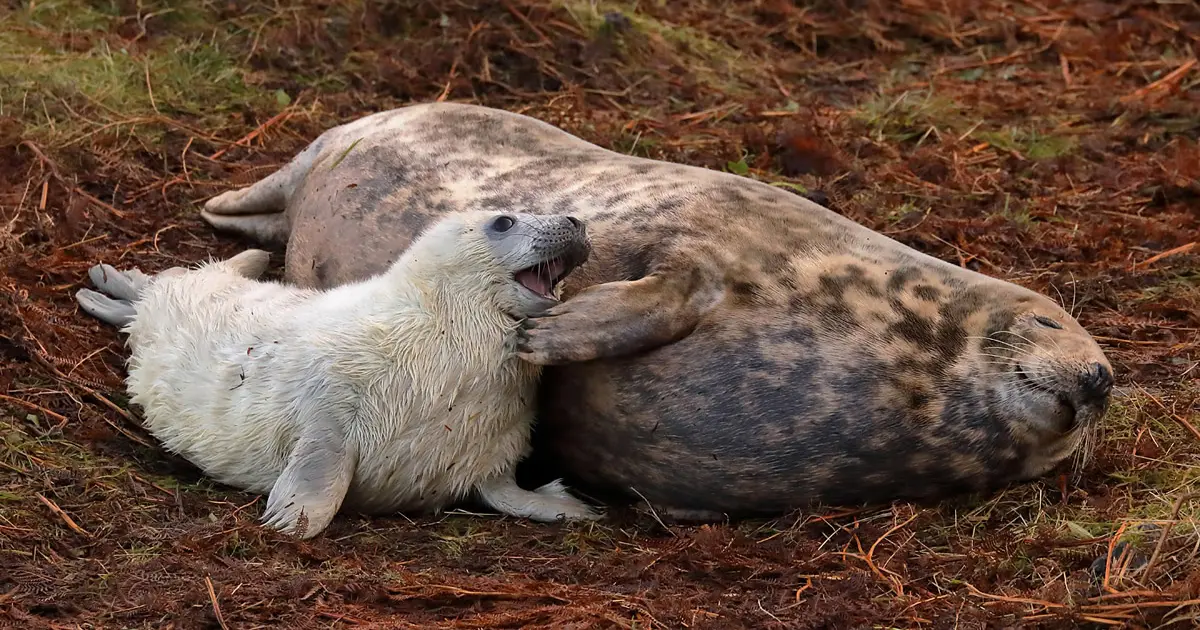
This is the question that sends most people to their phones, and the answer is usually to do nothing except keep back. The National Trust explains that a lone pup usually has a mother nearby in the water, who needs you to stay away before she will return. Pups may cry, which can sound distressing even when the pup is fine. The RSPCA points out that mothers leave their pups very early in life, when they are weaned at three to four weeks old.
BDMLR gives two useful rules of thumb. A seal with a white, long-haired coat in autumn or winter is probably still suckling, as is a small seal under about a metre long seen alone between June and August. Its hotline can give you specific advice.
Do
- Watch from a distance. The RSPCA suggests a pup can be monitored for 24 hours to see if the mother returns.
- Keep other people and dogs away.
- Call for help if you see wounds, an entangled animal or a dog attack.
Do not
- Touch it, pick it up or move it towards the sea.
- Try to feed it, which the GOV.UK code lists as a form of disturbance.
- Stand between a seal in the water and a pup on the beach.
For a seal that seems to be in trouble, the numbers are BDMLR on 01825 765546, or the RSPCA on 0300 1234 999 in England and Wales. Be ready to give a precise location and a description, and to explain how long you have been watching. BDMLR says signs of ill health include noisy, rapid breathing, thick mucus from the nose, wounds and cloudy eyes. In Scotland, our note on injured seabirds lists the Scottish SPCA line, which also deals with wild animals.
Dogs change everything
Seals have a painful bite, and the RSPCA warns that it is dangerous for people or dogs to get too close. The National Trust's preference is to leave dogs at home, or otherwise to keep them on a short lead and a safe 100 metres from seals. Dogs are not allowed in the fenced viewing area at Donna Nook, where the Lincolnshire Wildlife Trust explains that seals can carry diseases that harm dogs.
When pups appear, by region
Timing depends on the species and the coast. The RSPCA says common seals pup in June and July, and their young take to the water soon after birth. Grey seals are the opposite: pups keep to land for their first two or three weeks. The grey seal season moves round the country.
| Coast | Months | Source |
|---|---|---|
| West Wales | August to November | National Trust |
| South-west England | From September | RSPCA |
| Scotland | October and November | RSPCA |
| East coast of England | Around December; November and December at Donna Nook | RSPCA, Lincolnshire Wildlife Trust |
Where to watch seals well
Choose places where someone has already worked out how to keep visitors back. Donna Nook in Lincolnshire has a viewing area behind a fence, usually open from late October to early January depending on seal numbers. In West Wales, the National Trust points to the cliff tops at Martin's Haven and the St Davids peninsula, among other stretches of coast path. Grey seals also haul out around the Farne Islands.
The UK matters a good deal to this species. The National Trust says about half of the world's grey seals breed on our coastline, and the RSPCA estimates around 162,000 grey seals and 42,900 common seals in the UK, so the chance of an encounter is real on many beaches.
What the law says
GOV.UK guidance says the Conservation of Seals Act 1970 makes it an offence to intentionally or recklessly kill, injure or take a seal in England. It also advises against attempting a rescue yourself. The rules on disturbance and the wording for Scotland are different, and you can read more about how the law treats coastal wildlife in our note on disturbance. In practice, the courtesy of distance should mean you never come near any of these lines.