Home / Field notes / Note 1
Field note no. 1
Where and when to see puffins in the UK
Go between mid-April and early July. RSPB Bempton Cliffs in Yorkshire needs no boat, while the island colonies on Skomer and Inner Farne do. By August most puffins have gone back to sea, and no amount of patience will bring them to a cliff in winter.
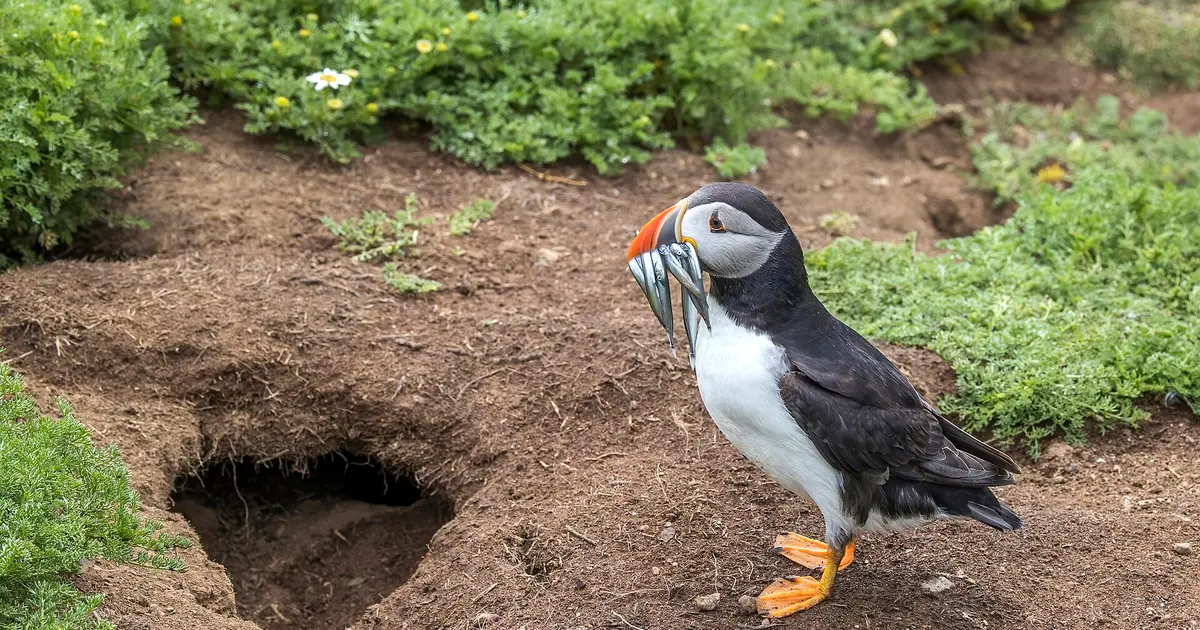

The window is shorter than people expect
Puffins spend most of the year away from land. The RSPB says that outside the breeding season most are far out at sea, many of them in the Atlantic and some in the North Sea. They come ashore to breed, and that gives you a few months at most.
The dates published by the people who look after the colonies agree closely. The RSPB advises visiting Bempton between April and mid-July. On Skomer, the Wildlife Trust of South and West Wales says puffins start arriving in mid-April, are present from May to July, begin to leave in mid-July and have all gone by the end of that month.
So a day trip in the school holidays is a gamble. If your only free week is in August, you may do better with the other birds on the plates in this guide, because a cliff can look busy long after its puffins have left.
Three colonies compared
| Site | Getting there | Worth knowing |
|---|---|---|
| RSPB Bempton Cliffs, East Yorkshire | By road, then level paths to the cliff top | Mainland site. Dogs on a short lead only. Scooters can be booked. |
| Skomer, Pembrokeshire | By boat, on a booked day trip | Commercial day-trip bookings open on 1 December. No landings between October and April. |
| Inner Farne, Northumberland | By boat from Seahouses | Closed until 1 April 2027 at the time of writing. No dogs at all, including assistance dogs. |
Bempton Cliffs: the one you can drive to
The RSPB describes around half a million seabirds gathering here between March and August, with April to July the peak. Puffins nest on the cliff edge among gannets, kittiwakes and guillemots. It suits people who cannot manage a boat: there are level paths to the cliff top and to the Bartlett Nab viewpoint, and the reserve page lists accessible toilets, push wheelchairs and mobility scooters. Groups of ten or more need to book. Taking off or landing a drone needs permission from the site.
You will be looking across and down at birds on chalk ledges, so bring binoculars. Check opening times on the RSPB page before you set out, since the reserve page sends visitors to a separate page for them.
Skomer: the island of burrows
The Trust counts more than 40,000 puffins on Skomer, alongside close to 350,000 breeding pairs of Manx shearwaters and thousands of guillemots, razorbills and kittiwakes. Day trips sell through the Trust's booking partner, and the Trust's page sets out landing days and group rules. Those details change between seasons, so read the current page instead of relying on an old blog post. Fares are not quoted here for the same reason.
The Trust's code of conduct says dogs are not permitted on Skomer or Skokholm.
Inner Farne: the one with a boardwalk
The National Trust told visitors in November 2026 that the islands were shut for the season and would re-open on 1 April 2027, and it recommends booking a boat from Seahouses in advance. Around 200,000 seabirds nest across the Farnes each year.
The Trust's visitor guidance is unusually specific, and worth reading before you pack. Bags must be sealed, because a single rat could devastate birds that nest on predator-free islands. Stay on the boardwalk and keep your legs, arms and cameras behind the ropes, as puffin burrows run all over the island. Wear a hat for the Arctic terns, which may peck your head, though not a hard hat or cycle helmet, which can damage their beaks.
Other places the RSPB lists
The RSPB's puffin page names further sites around the coast, which may be nearer to you:
- Scotland's mainland: Troup Head, Fowlsheugh, Dunnet Head and the Mull of Galloway
- Orkney and Shetland: Hoy, North Hill on Papa Westray, Noup Cliffs and Sumburgh Head
- Wales: South Stack on Holy Island
- Northern Ireland: Rathlin Island
A place on that list is no promise of a close view. Numbers vary from one site to another and the RSPB itself rates puffins as moderately difficult to see, so contact the reserve for recent news if you are travelling far.
What you are actually looking for
From a distance a puffin is a small black-and-white bird, and on a crowded cliff it is easy to confuse with its relatives. The RSPB's field marks are a black back, white underparts, large pale cheeks and a tall, flattened, brightly coloured bill, with bright orange legs in summer. If what you are looking at has a thin dark bill or a deep black one, it is probably one of the birds covered in our note on telling a guillemot from a razorbill.
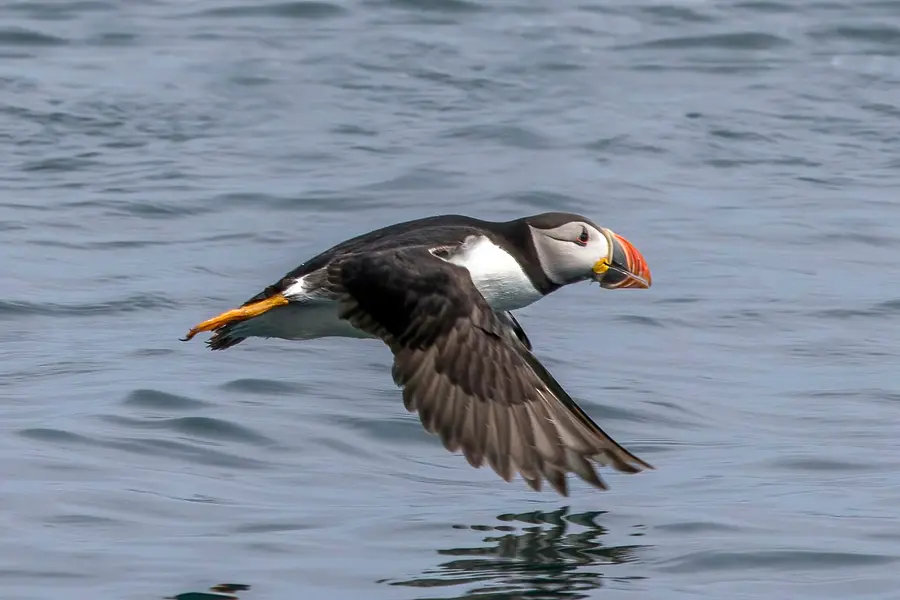 Photo: Charles J. Sharp, CC BY-SA 4.0, via Wikimedia Commons, cropped.

That colour is seasonal. In winter the face and belly fade to grey, the colourful outer bill is shed and the legs turn a muted yellow. It is one more reason the bird of the postcards is a summer sight only.
Watching without getting in the way
On a reserve, the paths and ropes set the distance for you, so stay behind them. Away from managed sites, GOV.UK advice for England is to stay at least 100 metres from wildlife on foot, to keep dogs on a lead, and to move away if a bird shows signs of disturbance. Burrow-nesting birds add a particular hazard, because the ground you are standing on may be someone's nest. We explain what the law does and does not cover in our note on disturbing nesting seabirds.
Why a visit is worth treating carefully
The puffin is on the UK Red List. According to the RSPB, citing Seabirds Count 2023, about 23% of UK puffins have been lost in the past 20 years, and the species has been heavily affected by climate change and industrial-scale overfishing. Sandeels are a staple food for puffins in this part of their range. The UK banned industrial sandeel fishing in the English North Sea and all Scottish waters in 2024, and the RSPB says it is working to defend that ban after a challenge from the EU. The UK holds about 9% of Europe's puffins, so what happens on these few cliffs matters beyond the UK.
None of this is an argument for staying at home. It is a good argument for booking early, for keeping a spare day in case the sea is too rough for a crossing, and for accepting that a distant view through binoculars still counts as seeing a puffin.