Home / Field notes / Note 6
Field note no. 6
Can you see dolphins from the shore in the UK?
Yes. Bottlenose dolphins are regularly seen from land at Chanonry Point on the Moray Firth and New Quay pier in Cardigan Bay, and neither needs a boat. Nothing is guaranteed, so plan for a long wait on a calm day with a rising tide.
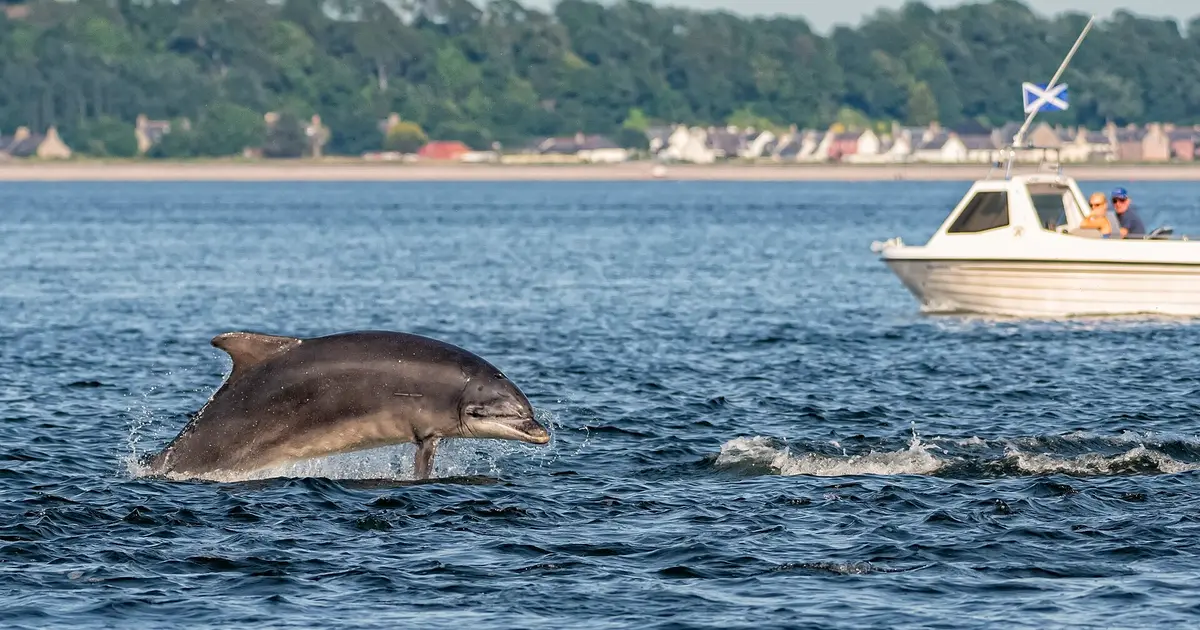

Watching from land has one big advantage over a boat trip: nothing you do on a headland will push a dolphin off its course. Animals that come in close are there by their own choice, and you get to see what they do when nobody is following them. It takes more patience, but the view can be excellent.
Two reliable places to start
Chanonry Point, Moray Firth
The local guide Black-Isle.info calls this one of the best places in Europe for watching dolphins from the land, and says the resident bottlenose pod often comes close to shore. Between April and August it advises arriving from low tide onwards, because dolphins often come in on the rising tide to hunt salmon and sea trout. From September to March there is little tidal pattern and sightings become less frequent in some winter months. Grey seals, common seals and harbour porpoises can be seen there all year.
New Quay pier, Cardigan Bay
The Sea Watch Foundation runs land-based watches from New Quay pier every day from April to October, and says these watches are always open to the public. It reports that dolphins often come very close to the pier, and that some well-marked animals can be identified at a glance by experienced watchers. Cardigan Bay has a bottlenose population of about 200, according to the same page, and the charity also lists harbour porpoise, Risso's dolphin and common dolphin among the animals in the bay.
A public watch is a useful way to begin, since you get someone who knows what they are looking at standing next to you. Check the Foundation's site for this year's arrangements before making a long journey.
How to run your own watch
Sea Watch's New Quay watches last two hours, which is a good guide for your own. You will see very little in ten minutes.
- Pick a calm day. Rough water hides fins. Sea Watch's Orca Watch volunteers only start a land watch at sea state 3 or below, meaning occasional white caps, and at a safe wind speed. That is a sensible threshold for you as well.
- Get some height if you safely can. A headland or pier gives you a wider view, and you do not need to go near an unfenced edge to get it.
- Use your eyes first. Scan the water slowly with the naked eye, then raise binoculars when something catches your attention. Take turns if you are with others. Sea Watch's photography advice suggests lookouts covering every direction.
- Keep a note. Write down the time, place and what you saw. Your sightings may be useful to recording schemes such as those run by Sea Watch.
As for cameras, Sea Watch suggests a lens that reaches 200mm or more, partly to avoid getting too close to the animals. Do keep the camera in your hand, because a surfacing animal does not wait for you to find it in your bag.
What you are likely to see
Bottlenose dolphins are the headline at both sites, and a leap is a bonus, not the norm. More often you will see a dark back and a fin rolling at the surface. Harbour porpoises occur at both places too, so give any small dark fin a second look. Do not be disappointed by a quiet session, as seals and passing gannets make good company.
A code that applies on land too
It is easy to assume a marine code is only for boats. But NatureScot says the Scottish Marine Wildlife Watching Code applies to watching from the shore as well as at sea. It is guidance rather than law, and it aims to reduce disturbance and improve your chances of seeing wildlife.
From land, this mostly comes down to staying off anything that would make you part of the problem. Stay on paths and do not walk into the water or wade out towards animals. Keep dogs under control, as the GOV.UK code for England asks. Avoid flying a drone over them, which is covered in our note on disturbance and the law.
Signs of disturbance are worth learning anyway, because they let you recognise when a passing boat is causing trouble. The GOV.UK code lists tail or flipper slapping, diving or surfacing less, bunching together and unpredictable movement.
Thinking about a boat as well?
If you would like to go out on the water too, NatureScot recommends choosing a tour operator accredited by the Wildlife Safe (WiSe) Scheme, as such operators should know how to interact with animals without causing disturbance. If you handle your own craft, the GOV.UK code asks you to stay 100 metres from marine wildlife, keep below 6 knots, and never pursue animals. If dolphins approach to ride your wake, keep a steady speed and direction and let them leave when they choose.
This has legal weight. GOV.UK says all dolphin, porpoise and whale species are protected in UK waters, and disturbing them is an offence under the 2017 Habitats Regulations and, except for porpoises, under the Wildlife and Countryside Act.
If you find one stranded
A live dolphin or porpoise on the beach is an emergency. Call British Divers Marine Life Rescue on 01825 765546, which is staffed around the clock. Do not try to refloat it, because the marine code says not to return animals to the sea. BDMLR's page gives instructions for what to do while you wait, including protection for yourself, as these animals can carry diseases that pass to humans. For a dead one, the Cetacean Strandings Investigation Programme takes reports on 0800 652 0333 in England and Wales. Our note on injured and dead seabirds covers birds on the same stretch of beach.
Practical things nobody tells you
Sea Watch warns that some of its land-watch sites are relatively remote and lack facilities, so carry water and warm layers. Check tide times before you go, as the GOV.UK code advises, because a rising tide is what you came for and it can also cut you off on a spit or beach. Give other watchers room and keep your voice down. And if you leave without seeing a fin, you have still spent two hours watching the sea, and that is a fair way to spend an afternoon.